Where Does It
Actually Hurt?
Take 90 seconds. Get your personalized movement plan — built by PTs who explain the why before the fix.
The Spine & Neck
From fossilized thoracic curves to sciatica that won't quit — the spine holds more stories than any MRI can tell.
“Three years of standing desks, lumbar pillows, and YouTube stretches. My PT watched me walk for 45 seconds and said "your thoracic spine is locked at T4–T6." Nobody had ever said those words to me. We spent six sessions on mobility I didn't know I'd lost. The headaches stopped in week two.”
“Every doctor said "stress" or "posture." My PT found that my cervical flexors were essentially offline — my traps were doing all the work holding my head up. When she showed me on the diagram exactly which muscle had quit, something clicked. I stopped guessing and started fixing.”
“Post-fusion L4–L5. Everyone warned me I'd never run again. My PT was the first person to say "let's see what your hip extensors can do before we decide that." Spoiler: they could do a lot. Eight months later I finished a 10K.”
“The pain was in my leg but the problem was in my back. I'd been stretching my hamstring for half a year. My PT explained neural tension in five minutes using a piece of string. We stopped stretching and started nerve mobilization. Two weeks later I drove without wincing.”
Spine or neck pain that hasn't responded to stretching alone.
The Shoulder
The most commonly mismanaged joint in the body. Usually not what you think it is.
“I'd been rolling my shoulder on a lacrosse ball every morning for 730 days. My PT tested my external rotation strength and said "your infraspinatus is at about 40% — no amount of stretching fixes a weakness." Six weeks of targeted loading and I was back to overhead pressing.”
“The click was terrifying. I was convinced I'd torn something. My PT explained subacromial space narrowing in a way that finally made sense — she showed me how my scapula wasn't rotating properly, making the space smaller with every rep. Fix the scapula, fix the click. She was right.”
“Every website said "12–18 months." My PT said "with the right mobilization, we can compress that." We worked through the capsular pattern systematically. I had full range back in four months. The key was understanding I wasn't "warming it up" — I was breaking up actual adhesions.”
Shoulder pain that stretching has failed to fix — for weeks, months, or years.
Knee & Hip
From ACL reconstruction fear to hip pain misdiagnosed as a tight muscle — these joints talk to each other.
“My surgeon cleared me at 6 months. My PT was the one who said "cleared to walk doesn't mean cleared to cut." She ran me through a hop test battery. My operated leg was at 67% of the other side. We spent two more months on neuromuscular control. At 8 months I trusted my knee for the first time.”
“The difference between up and down stairs is eccentric quad control. My PT explained this in 90 seconds and I finally understood why every quad exercise I'd tried hadn't helped — I was doing them concentrically. Three weeks of slow, loaded step-downs and the stairs stopped being something I planned around.”
“Turned out to be labral irritation, not hip flexor tightness. My PT said the two feel identical but respond to completely different treatments. She tested hip internal rotation in 90° flexion — I had almost none. We worked on posterior capsule mobility instead of hip flexor stretching. Four weeks later, zero groin pull sensation on long runs.”
“Eight weeks post-TKR and I still couldn't bend past 90 degrees. My PT found I'd developed scar tissue in the suprapatellar pouch — nobody had told me to mobilize the kneecap itself. Two weeks of patellar mobilization and manual therapy, and I hit 120 degrees. My surgeon was surprised. I wasn't anymore.”
Knee or hip pain that hasn't responded to rest, stretching, or generic rehab exercises.
Find My Movement Plan
No email required yet. We show you the plan first — you decide if it's worth your inbox.
Where is your primary pain or restriction?
The relief of understanding arrives before the relief of movement.
Every session begins with your PT explaining exactly what structure is involved and why your body is protecting it. Then we get to work.
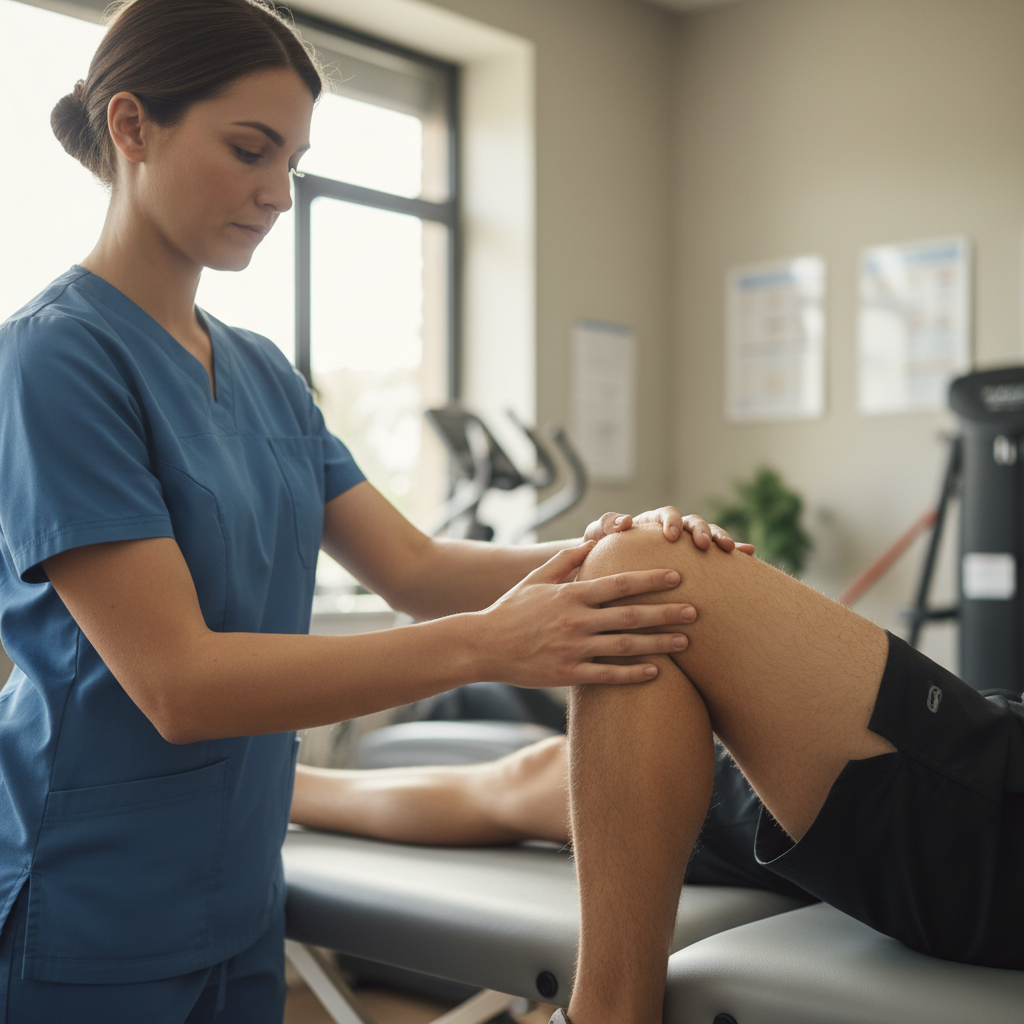
Biomechanics explained in plain English
You leave every session understanding exactly what is happening in your body — not just what to do about it.
Home programs you'll actually do
3–5 targeted exercises, not 20-page printouts. Each one explained with the why, not just the how.
One-on-one, 50-minute sessions
No tech aides. No double-booking. Your PT is in the room with you for the full hour.
Book a free 15-minute phone screen. Tell us where it hurts — we'll tell you if we can help before you commit to anything.
Book a Free Screen